Horsforth roofs, part by part
Horsforth likes to call itself a village, but it is really a sizeable town in its own right, sitting on the north side of the Aire valley between Kirkstall, Rawdon and Cookridge. It grew from a cluster of farms and quarries into a mill and commuter town, and it kept its own identity when it joined Leeds in 1974. The result, from a roofer's point of view, is a place where a single walk takes you past almost every kind of roof built in West Yorkshire in the last two hundred years.
That variety is the reason this business is named after the town. A slate repair on a gritstone cottage, a hip tile rebed on a 1930s semi, a valley relined on a Cragg Wood villa and a canopy fixed on a house built ten years ago all need different materials, different fixings and a different eye. Below is how the roofs break down across Horsforth, and what tends to go wrong in each part.
Town Street, Long Row and the old centre
The oldest part of Horsforth runs along Town Street and the lanes off it, with Long Row, Church Lane and the streets towards The Green. Here the buildings are mostly local stone, roofed in Welsh blue slate or, on the very oldest cottages, heavy Yorkshire stone slate. The shops along Town Street have flats or storerooms above, with slate roofs to the street and small flat roofs or lean-tos at the back.
The faults we find in the old centre are the classic ones for stone and slate. Iron nails rust and slates slip one at a time. Shared chimney stacks lose their pointing and their flaunching, and the lead where they pass through the slates was often renewed decades ago with sealant rather than being tucked into the joint. Where a lean-to or a rear flat roof meets a stone wall, the flashing has to follow irregular joints, and when it is stuck to the face instead, damp appears inside along the wall. On Long Row and the tighter lanes, the street side often needs a tower or a scaffold licence, while rear roofs can sometimes be reached from yards.
Stone terraces in Woodside, West End and the Fink Hill side
Beyond the centre, rows of nineteenth-century stone terraces fill the streets climbing towards Woodside and West End and down towards Fink Hill and Low Lane. These were built for mill and quarry workers and later for commuters on the railway, and most still have their original slate on battens with no felt underneath. A slipped slate on one of these roofs puts rain straight onto the lath and plaster below.
Through-terraces share a ridge, a gutter line and a stack every two houses, so repairs are often a conversation with the neighbours as much as a job on the roof. Many of these houses have had loft conversions, and the dormers on a single row can range from neat slate-hung boxes to tired felt tops from the 1970s. We look at the dormer and the main slope together, because water from one often shows up under the other.
Hall Park and the inter-war roads
Around Horsforth Hall Park and along the roads between the centre and the ring road, the houses change to inter-war semis and detached houses: hipped roofs in clay or concrete tiles, bay windows with their own small roofs, brick stacks on the party wall and rendered or pebble-dashed upper walls. Plenty of them still carry their original roof from the 1920s and 1930s.
Here the hips and ridges are the first thing to go. They were bedded in mortar that is now close to a hundred years old, and a windy winter loosens them. Bay roofs, whether tiled, leaded or felted, leak where they meet the wall above the window. The timber fascias and soffits on these houses have often been capped in plastic, and sometimes the timber behind has carried on rotting. When an inter-war roof finally needs replacing, the tiles can often be matched, and the work includes a proper breathable membrane that these houses never had.
Newlaithes, New Road Side and the ring road edge
The outer ring road and the A65 at New Road Side cut across the south and east of Horsforth, and the housing along them is mainly inter-war and post-war semis, bungalows and short terraces, with the Newlaithes side and the roads towards Kirkstall full of mid-century houses. Concrete interlocking tiles dominate, with flat-roofed garages, porches and kitchen extensions added in every decade since.
These roofs face the traffic, the wind funnelled along the valley and the grit thrown up by a busy road. Mortar verges crumble, felt at the eaves becomes brittle and lets water behind the gutter, and the flat roofs over garages and extensions reach the end of their life with soft chipboard decks. Being by a main road also means access needs thought: a tower on a front garden is easier than anything on a busy pavement, and we plan that before the day.
Cragg Wood and the big houses above the Aire
On the slope between Horsforth and Rawdon, the Cragg Wood area is a different world: large Victorian and Edwardian houses set among trees on the hillside above the river, many now split into apartments. Their roofs are steep slate with several valleys, hidden gutters behind parapets, tall stacks with multiple flues, decorative ridge tiles and a great deal of lead.
Roofs like these need patience. Valleys fill with leaves from the trees every autumn, and a blocked valley or parapet gutter sends water straight into the top floor. Long runs of old lead crack at the joins. Stacks need a proper scaffold to work on safely. Where a house is divided into flats, we deal with the freeholder or managing agent and send photos of everything we find, so decisions can be made without anyone having to climb up.
Newer estates and infill
Horsforth has also grown with new housing on old industrial sites and in the gaps behind older roads, including the Horsforth Vale side and the closes near Leeds Trinity University and Brownberrie. These have modern trussed roofs with concrete tiles, breathable membranes, dry-fixed ridges and verges, and small GRP or lead canopies over doors and bays.
Newer roofs are not trouble-free. Dry verge caps can work loose in a gale, mortar-free ridge systems can lift if a fixing was missed, and canopies over doors and bays are the commonest source of a small leak. These are usually quick fixes, and we treat them as such rather than suggesting anything bigger.
Weather, height and access in Horsforth
Much of Horsforth is high ground. The streets up towards Cragg Hill, Brownberrie and Woodside look straight out over the valley and take the full force of westerly gales, while the lower roads near the river and the ring road catch the wind funnelled along the Aire. Wind-driven rain is the cause of many Horsforth leaks that only appear in storms: water pushed up under verges, slates and flashings that keep out ordinary rain without trouble.
Access varies as much as the houses. Terraces on steep streets need towers set level on sloping pavements; semis with driveways are straightforward; the big Cragg Wood houses need full scaffolds. Parking on Town Street is tight, so we arrange where vans and materials go before we arrive. Every one of these things is planned ahead and shown in the written price.
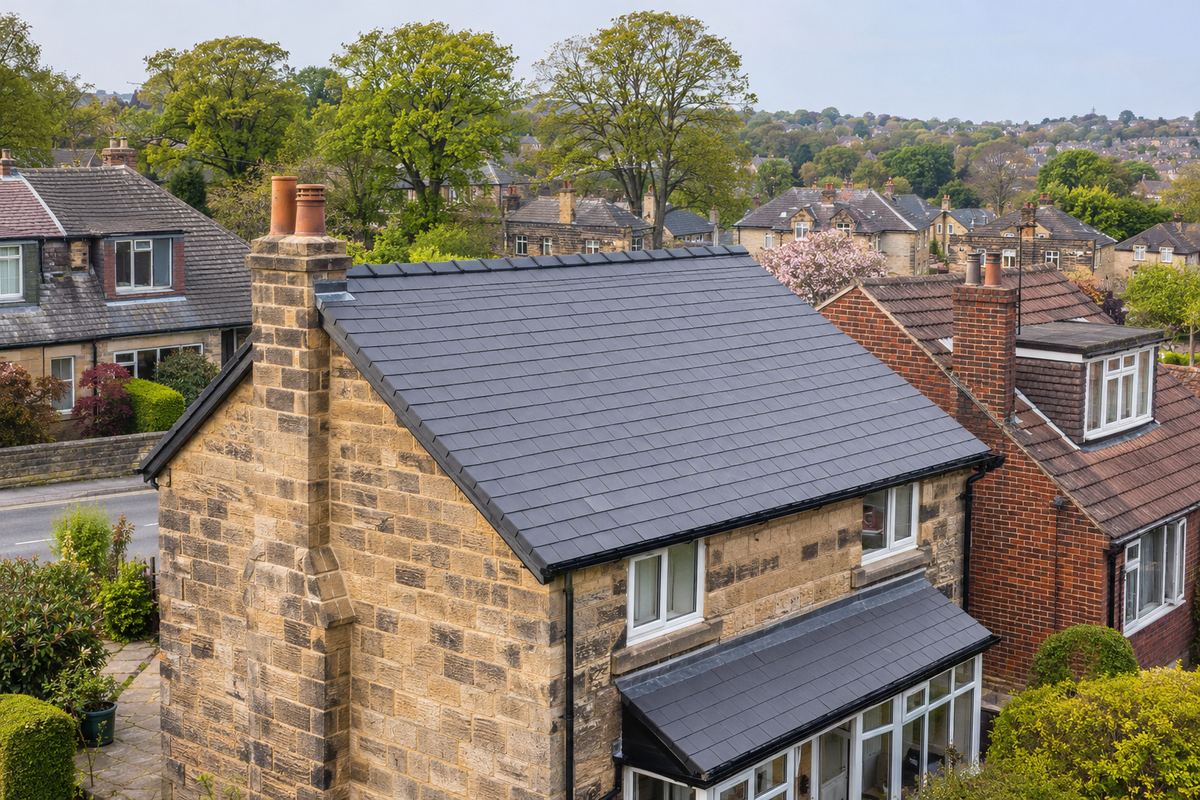
The houses and roofs of Horsforth
Stone terraces and cottages
Stone-built terraces in Horsforth were roofed with thin blue slate on timber battens, many without any felt underneath. Repairs on a Horsforth row need slate of the same size and careful work at the party line with next door.
Inter-war semis
Semis from between the wars line the main roads of Horsforth, with tiled roofs, rendered or pebble-dashed upper walls and timber fascias. In Horsforth, the roofline boards and the bay tops tend to need attention before the main roof does.
Victorian and Edwardian houses
Double-fronted and semi-detached villas in Horsforth often have attic rooms with dormers, decorative ridge tiles and finials. Matching those details on a Horsforth house matters as much as keeping the water out.
Newer estates
Houses built in Horsforth since the 1990s have concrete tiles, dry-fixed ridges and verges and uPVC roofline. Problems on newer Horsforth roofs are usually small: a lifted ridge cap, a cracked tile or a blocked valley.
What tends to go wrong in LS18
- Slates slipping as old nails rust through
- Shared stacks with tired pointing and lead
- Loose hip and ridge tiles on old mortar
- Small bay roofs leaking at the wall
- Valleys and hidden gutters overflowing
- Long lead details cracking with age
- Dry verge caps working loose
Unsure what the Horsforth roof is doing? Try the leak checker, or send a photo from the street or a window.
Roofing services in Horsforth
Slate & Tile Repairs
Slipped slates refixed, cracked tiles swapped, nail sickness spotted early. Matching sizes and profiles sourced.
More on this →Chimney Repairs
Pointing, flaunching, pots, caps and new lead around the stack, or an unused stack taken down safely.
More on this →Ridge, Verge & Valley
Ridge tiles rebedded or dry-fixed, gable verges renewed, valleys cleared and relined in lead or GRP.
More on this →Fascias & Soffits
Rotten roofline boards stripped back to sound timber and renewed, with eaves vents and gutters refitted.
More on this →Lead Flashing
Aprons, step flashings, soakers and back gutters cut into the joint and dressed by hand, not stuck on.
More on this →Roof Repairs
One weak point found and put right: slates, ridges, lead or flat roof, matched to what is already on the house.
More on this →Also in Horsforth: leaking roofs, flat roofs, guttering, storm damage, roof replacement.
Roof care through the year in Horsforth
- Autumn: Before the clocks go back is the time to look along the Horsforth roof from the street for anything out of line.
- Winter: Frost splits porous tiles and loosens old mortar on ridges and verges, so loose pieces often show up on Horsforth paths in January and February.
- Spring: Spring is a sensible time in Horsforth to book any work found over the winter, before the busy summer months.
- Summer: Long dry spells are the best weather for re-roofing, lead and flat roof work in Horsforth, and mortar cures well when it is not freezing.
How we work in Horsforth
- Found before it is priced: in Horsforth we trace the fault from inside and out before writing anything down, so you pay to fix the cause.
- Repair if it will last: when a roof in Horsforth only needs one slate, one flashing or one ridge put right, that is the job we price.
- Access shown separately: ladders, towers or scaffold for a roof in Horsforth are planned ahead and listed as their own line.
- Materials that match: slate, tile and ridge on a Horsforth house are matched by size and profile, new or reclaimed.
Roofs in Horsforth are covered as part of the wider Horsforth patch; nothing changes about how the job is looked at or priced.
Areas near Horsforth
The six areas nearest to Horsforth, with the distance between their centres:
- RawdonLS19 · 1.9 km away
- TinshillLS16 · 2.6 km away
- HawksworthLS5 · 2.6 km away
- Ireland WoodLS16 · 2.8 km away
- CookridgeLS16 · 2.8 km away
- YeadonLS19 · 2.9 km away
Or search every area by town or postcode.
The highlighted pin is Horsforth; the others are the six nearest areas with their own pages. Map data © OpenStreetMap contributors.
Roofing in Horsforth: questions
- Horsforth is our home patch and the place we know best, but we cover the whole of the Leeds district. Rawdon, Cookridge, Yeadon, Kirkstall and the other areas nearby are covered in exactly the same way: we look first and then price the work in writing.
- It is normal for houses of that age, and the roof can stay sound for a long time as long as the slates stay in place. The risk is that a single slipped slate lets rain straight through. When the roof is eventually relaid, a breathable membrane goes in at the same time.
- Parts of Horsforth, including the old centre and Cragg Wood, are covered by conservation areas. Repairs like for like are normally fine; changing the roof material or the look of a street-facing roof may need permission. If we think it applies to your house, we say so before you decide.
- Yes. We deal with the freeholder or managing agent, arrange access with residents, and send photos and a written price for any work on the shared roof, valleys, gutters or stacks.
- Yes. Horsforth (LS18) is part of our patch, which spreads out from Horsforth across north-west Leeds and the rest of the district. Every roof in Horsforth is looked at before it is priced, and the price goes in writing.
- For a Horsforth roof, phone the office, use the call-back form on this page or send a photo through the roof photo check. We then look at the Horsforth roof, explain what we find and send a written price with the access listed separately.
- Yes. For lets in Horsforth, access is arranged with the tenants, and the photos and written price go to whoever manages the property.
- Horsforth is covered from Horsforth as part of the same patch, and the distance makes no difference to how the job is looked at or priced. The price for a roof in Horsforth comes from the work and the access it needs, nothing else.