Lead Flashing in Horsforth and around
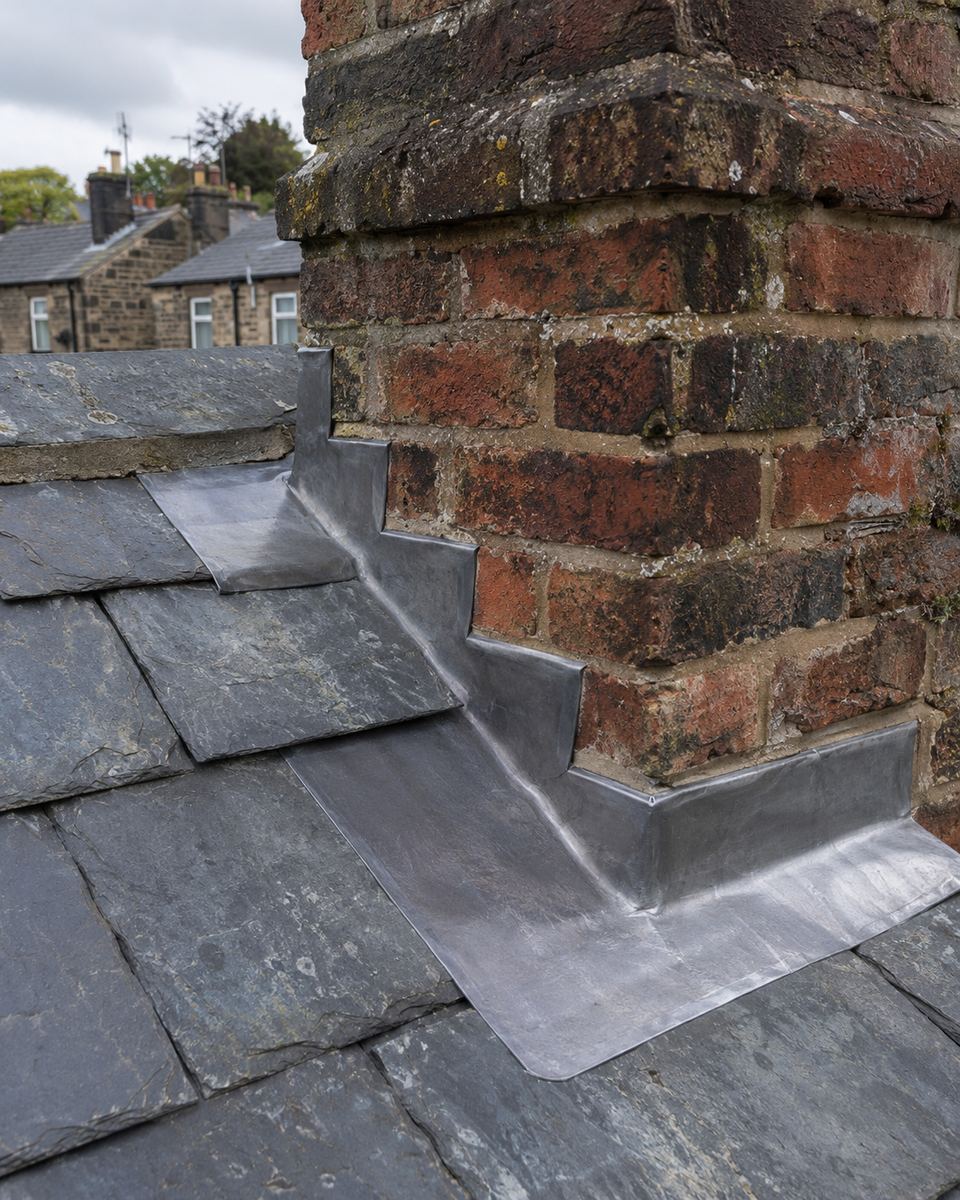
Lead is used on roofs because it can be shaped by hand to fit almost any junction and then left to weather. Flashings are tucked into a mortar joint in the wall or chimney and dressed down over the slates. Soakers sit under each slate along a side wall. Aprons cover the front of a chimney, back gutters run behind it, and lead lines valleys, bay tops and small flat roofs on older houses.
Many of the leaks we find in Horsforth start at lead. Sometimes it is old lead that has cracked after decades of movement. More often it is lead that was never fixed correctly: pieces too long to move without splitting, flashings stuck to the face of a wall with mastic, or step flashings cut in one long strip. Stone walls in particular need the lead set into a sound joint and pointed in, because water runs down the face of the stone and straight behind anything glued on.
We renew leadwork in the right thickness for the job, in lengths that can move, fixed with clips and wedges and pointed into the joint. On houses where lead theft is a concern, we can talk about alternatives for some details, but on most roofs lead is still the best material for the job.
Signs of failing leadwork
- A flashing that has pulled out of the mortar joint above it
- Mastic or sealant smeared along the top of a flashing
- Cracks or splits in the lead, often at folds or joins
- Lead that lifts and flaps in the wind
- Damp on a ceiling or wall next to a chimney or side wall
- Stains on the felt in the loft below a chimney or abutment
- Missing lead on a bay top or porch roof
- Green or grey streaks on the slates below the lead
Why lead flashings fail
Lengths too long
Lead expands and contracts with temperature. A long piece fixed rigidly cannot move and eventually cracks. Good practice keeps lengths short and lapped.
Glued on, not tucked in
A flashing stuck to the face of a wall with sealant relies on the sealant. Once that hardens and cracks, water runs straight behind.
Pointing failure
When the mortar holding a flashing in its joint crumbles, the lead lifts and rain gets in behind it.
Wrong thickness
Lead that is too thin for its position is easily damaged and lifted by wind; lead that is too thick for a small detail can be hard to dress properly.
Theft and damage
Lead on lower roofs, bays and porches is sometimes stolen or damaged by ladders. Missing lead is a direct route for water.
How we renew lead flashings
1. Find the failure
We check the whole junction: the flashing, the soakers or step flashings under it, the pointing and the slates around it.
2. Remove the old lead
Failed lead and sealant are taken off, and the joint is raked out ready for the new flashing.
3. Cut and dress new lead
New lead is cut to the shape of the junction, in sensible lengths with proper laps, and dressed by hand to sit tight to the slates or tiles.
4. Fix it properly
The top edge is turned into the joint, held with lead wedges and pointed in. Long edges are held with clips so wind cannot lift them.
5. Treat the surface
A coat of patination oil stops the white staining new lead can leave on the slates and walls below.
Worth knowing
Lead codes
Lead sheet is made in different thicknesses, known by code numbers. Flashings, soakers and valleys each need a suitable code; we choose it for the detail, not whatever is thinnest on the van.
Stone walls
On the stone terraces and older houses in Horsforth, Rawdon and Calverley, the joints are irregular. The lead has to be cut to follow them, which takes longer but stays put.
Lead alternatives
Some non-lead flashing materials exist and suit certain details, especially where theft is a risk. They are not right for every junction, and we will say where they suit.
Small flat lead roofs
Bays, porches and some older dormers have small lead roofs. These need rolls and drips to let the lead move, and can often be relaid rather than replaced.
Related roofing work
Chimney Repairs
Pointing, flaunching, pots, caps and new lead around the stack, or an unused stack taken down safely.
More on this →Leaking Roofs
Water runs before it drips. We follow it back from the stain to where it really gets in, then fix that.
More on this →Flat Roofs
Garages, kitchen extensions, dormers and bays repaired or renewed in EPDM, GRP fibreglass or reinforced felt.
More on this →Ridge, Verge & Valley
Ridge tiles rebedded or dry-fixed, gable verges renewed, valleys cleared and relined in lead or GRP.
More on this →Where we do this
Horsforth first, then everywhere else in the Leeds district. Nearby area pages where this comes up a lot: Horsforth, Rawdon, Calverley, Headingley, Adel, Bramhope, Farsley, Guiseley. Anywhere else: put your town or postcode into the area finder.
Lead Flashing: questions people ask
- A sealant can stop water for a short time, but it does not last and it hides the problem. A flashing that has lifted needs re-fixing into its joint; one that has cracked needs replacing.
- Lead moves with heat. Short lengths with overlaps can move without cracking. A single long piece fixed tight will eventually split.
- Lead on low roofs, bays and porches is sometimes targeted. If that is a worry, we can talk about fixing methods and alternatives for the most exposed details.
- Fresh lead can leave white or grey streaks as it first weathers. We treat new lead with patination oil to prevent this.
- If the side wall leaks, the soakers under the slates are often part of it. Where they have corroded or were never fitted, we include them in the price.