Roof Replacement in Horsforth and around
Roofs across Horsforth are reaching the age where a full re-roof makes sense. Many of the inter-war semis still have their original tiles, battens and no proper felt at all. Post-war houses built with early concrete tiles and bitumen felt are now seventy years old. And the slate roofs on the stone terraces have often been patched so many times that the fixings are failing across whole slopes.
A re-roof is a big decision, so we spend time explaining what we have found and why we think replacement is the right call. We look in the loft, check the condition of the slates or tiles, the battens and the felt, and look at the chimneys, lead, gutters and roofline at the same time. If parts of the roof are worth saving, such as good slates that can be reused, we say so.
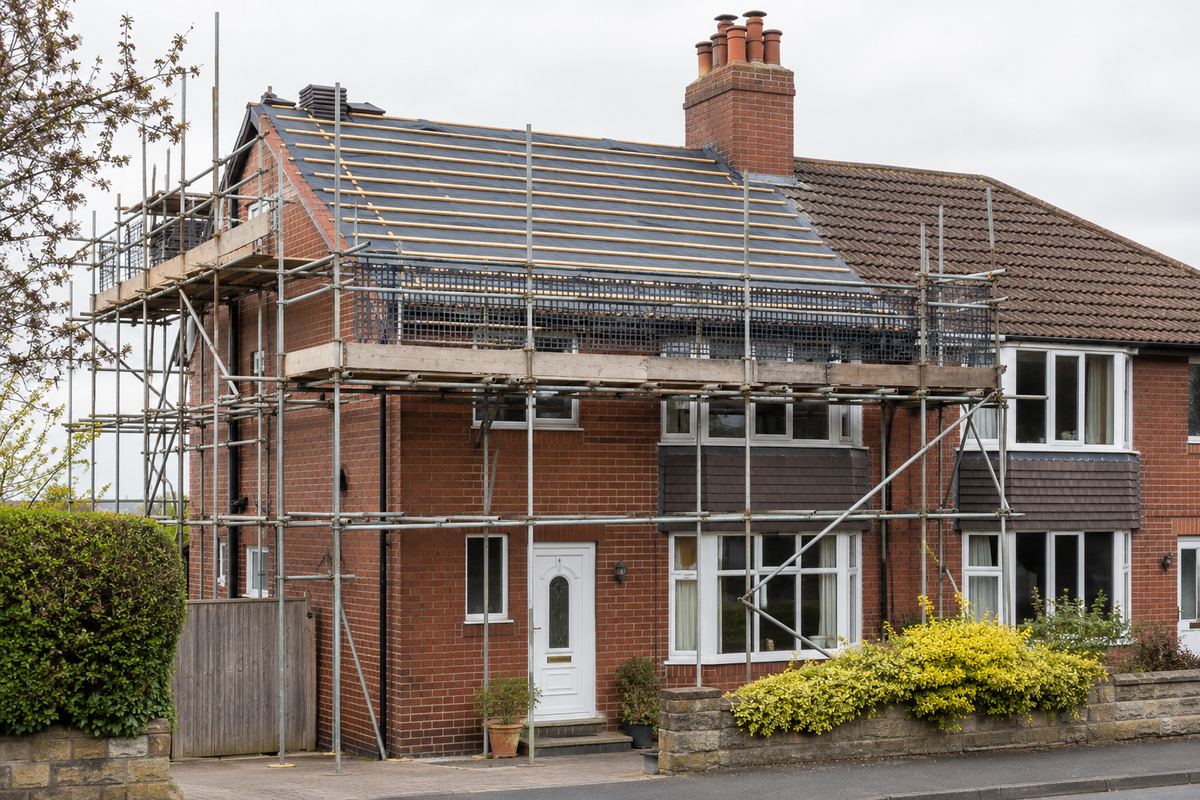
The work itself follows a clear sequence: scaffold, strip, check the timbers, fit a modern breathable membrane and new treated battens, relay the slates or tiles with the right fixings, then ridges, verges, valleys and lead. We keep you informed throughout, and the price is in writing before we start.
Signs your roof may need replacing
- Slates or tiles slipping every winter in different places
- Many tingles or past patch repairs across the slopes
- Daylight through the roof in several places from the loft
- Felt that is torn, brittle or missing altogether
- Battens that are soft or have broken
- A roof line that dips or sags
- Tiles that are crumbling, spalling or have lost their nibs
- Several leaks in different places over the last few years
Why roofs reach the end of their life
Fixings fail
Iron nails rust and battens rot. When the fixings go, slates and tiles slip, even if the slates themselves are still good.
Coverings wear
Concrete tiles lose their surface and become porous. Clay tiles crack with frost. Some slates delaminate.
Felt deteriorates
Old bitumen felt becomes brittle and breaks, especially at the eaves. Many older roofs never had any underlay at all.
Repeated repairs
Each repair disturbs the roof a little. A roof with dozens of repairs is often weaker than one that has had none.
Timber problems
Long-term leaks can rot rafters, wall plates and boards. These need putting right before the roof is relaid.
How a re-roof is done
1. Survey and price
We look at the roof inside and out and set out the work, materials, access and any timber repairs in a written price.
2. Scaffold
A full scaffold with edge protection is put up, with consideration for neighbours, paths and parking.
3. Strip
The old covering, battens and felt are removed. Reusable slates are sorted and stacked. Waste is taken away.
4. Timber check
Rafters and boards are inspected and any repairs are made. You are shown anything significant before we continue.
5. Membrane and battens
A breathable membrane is laid, followed by new treated battens set out for the slate or tile.
6. Relay
Slates or tiles are fixed with the right nails and clips, with ridges and verges dry-fixed or bedded, valleys lined and lead renewed.
Choosing a new roof covering
| Natural slate | Clay tiles | Concrete tiles | |
|---|---|---|---|
| Suits | Stone and Victorian houses, conservation areas | Inter-war and period houses | Post-war and modern houses |
| Weight | Light to medium | Medium | Heavier |
| Look | Thin, flat, dark grey or blue | Warm reds and browns | Wide range of colours and profiles |
| Notes | Reclaimed slate can be reused | Plain tiles need more fixings | Check the roof can take the weight if changing from slate |
Not sure what is on your roof? A photo from the street is usually enough for us to tell you.
Worth knowing
Reusing good slate
If the slates are sound but the nails have gone, they can often be stripped, sorted and relaid with new fixings. That keeps the look of the house and reduces cost.
Changing material
Swapping slate for concrete tile, or the other way round, changes the weight on the roof and may need planning permission in a conservation area. We advise before you decide.
Building regulations
A full re-roof may bring in building control, for example if insulation is being upgraded. We explain what applies.
Do it once
While the scaffold is up, it is worth looking at the chimneys, roofline, gutters and any flat roofs, so nothing is left that needs access again soon.
Related roofing work
Roof Repairs
One weak point found and put right: slates, ridges, lead or flat roof, matched to what is already on the house.
More on this →Slate & Tile Repairs
Slipped slates refixed, cracked tiles swapped, nail sickness spotted early. Matching sizes and profiles sourced.
More on this →Chimney Repairs
Pointing, flaunching, pots, caps and new lead around the stack, or an unused stack taken down safely.
More on this →Fascias & Soffits
Rotten roofline boards stripped back to sound timber and renewed, with eaves vents and gutters refitted.
More on this →Where we do this
Horsforth first, then everywhere else in the Leeds district. Nearby area pages where this comes up a lot: Horsforth, Rawdon, Cookridge, Adel, Bramley, Calverley, Pudsey, Yeadon. Anywhere else: put your town or postcode into the area finder.
Roof Replacement: questions people ask
- If the problems are in one or two places and the rest of the roof is sound, repairs make sense. If fixings are failing across the slopes, the felt is gone and repairs keep coming back, replacement is usually better value. We show you what we find.
- A typical semi or terrace is usually one to two weeks, depending on the size of the roof, the weather and what is found under the slates.
- Yes. The roof is kept weathertight at the end of each day. There will be noise and dust in the loft, so it helps to clear anything stored up there.
- Replacing like for like usually needs no permission. Changing the material or the look of the roof in a conservation area, or on a listed building, may. We tell you if that applies.
- Reusable slates may be kept for the job. Everything else is removed and disposed of properly.