Guttering in Horsforth and around
Every roof in Horsforth drains into a gutter of some kind. The stone terraces off Town Street and the older streets in Woodside often still have cast iron ogee gutters on stone corbels or brackets. Inter-war semis have cast iron or replacement plastic half-round. Post-war and modern houses mostly have uPVC on fascia boards. Each type fails in its own way.
The common problems are blockages from moss and leaves, joints that drip, runs that sag and no longer fall towards the outlet, and downpipes that are cracked or blocked at the bottom. In streets with mature trees, such as around Hall Park, Cragg Wood and the edges of the Horsforth woods, gutters fill quickly every autumn.
We clear, repair and replace gutters and downpipes, and we look at what is above them at the same time. A gutter that overflows at one point may be under a valley that sends more water there than the gutter can take, or below slipped slates that are dropping grit into it.
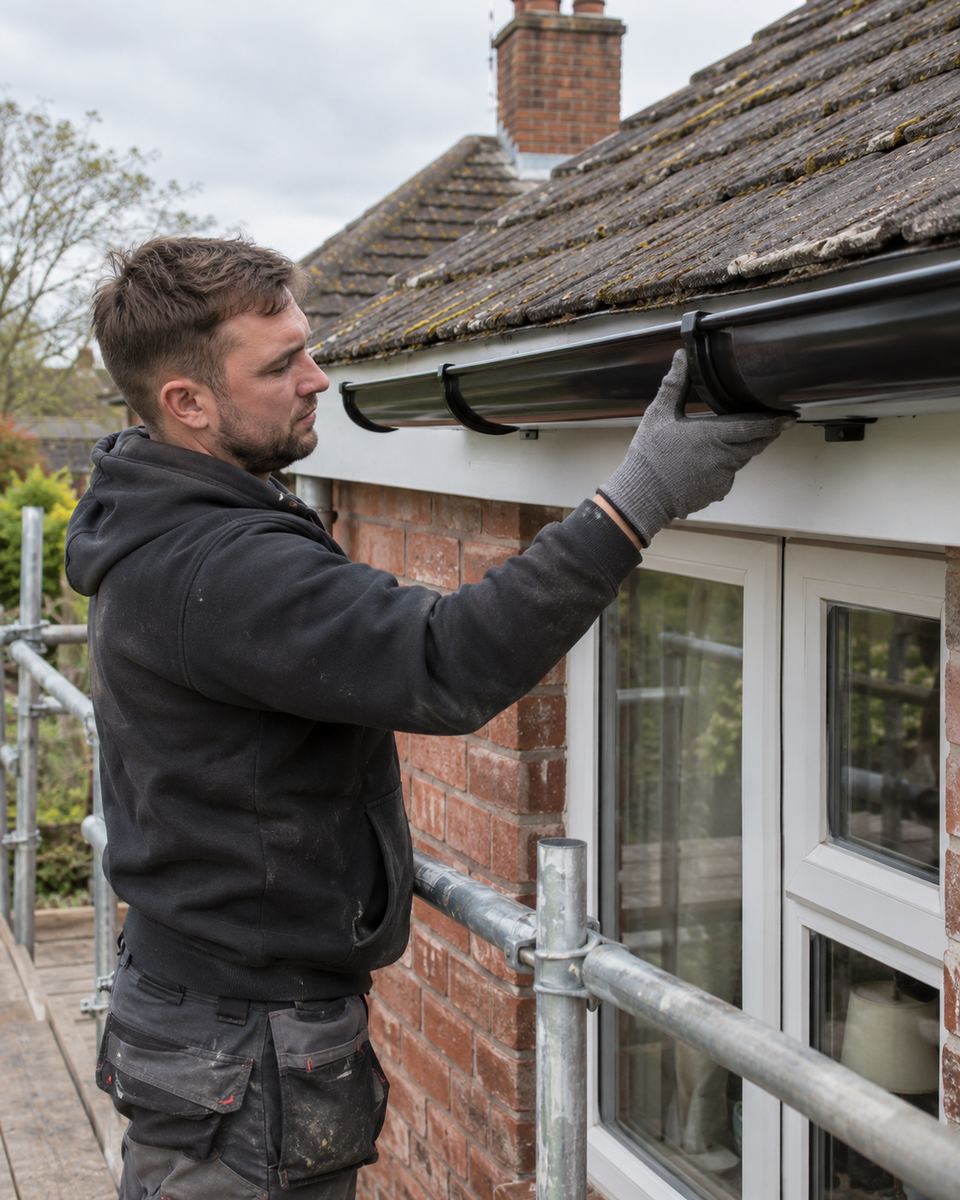
Signs your gutters need attention
- Water spilling over the gutter in heavy rain
- Drips from a joint or a bracket
- A green or dark stripe down the wall below the gutter
- Plants growing out of the gutter
- A run of gutter that dips or has pulled away from its brackets
- Damp patches on an inside wall below the eaves
- A downpipe with a crack or a blocked shoe at the bottom
- Puddling at the foot of the wall where a downpipe should discharge
Why gutters fail
Blockages
Moss from the roof, leaves, seeds and silt build up until water cannot reach the outlet. Blockages are worst under trees and below valleys.
Failed joints
uPVC joints rely on rubber seals that harden over time. Cast iron joints use bolts and sealant that rust and crack.
Sagging
Brackets that have come loose or rusted, or fascias that have softened, let the gutter dip, so water collects at low points and overflows.
Wrong size
On big roofs or below valleys, a standard gutter may be too small to carry heavy rain. Deeper profiles help.
Damage
Ladders resting on gutters, snow sliding off the roof and falling branches can crack or pull down runs.
What the work involves
1. Check the whole system
We look at the gutters, outlets, downpipes and the roof edge above them, and find where the water is actually going wrong.
2. Clear and test
Gutters and outlets are cleared by hand and the run is flushed with water to show any leaks or low spots.
3. Repair
Joints are resealed or the unions replaced, brackets are refixed or added, and sagging runs are reset to fall to the outlet.
4. Replace
Where a run is beyond repair, it is replaced in a matching or better profile. Cast iron can be renewed in cast iron, or replaced in uPVC where appropriate.
5. Downpipes
Cracked or blocked downpipes are cleared, repaired or replaced, and we check that they discharge into a drain or gully rather than against the wall.
Gutter types you will find in Horsforth
| Cast iron | uPVC | Aluminium | |
|---|---|---|---|
| Typical homes | Stone terraces, Victorian and older houses | Most post-war and modern houses | Some re-roofs and modern builds |
| Common faults | Rusted joints, cracked sections | Hardened seals, sagging | Joint seals, dents |
| Upkeep | Painting every few years | Clearing and occasional new seals | Clearing |
| Look | Traditional, heavy | Light, many colours | Smooth, can be seamless |
Not sure what is on your roof? A photo from the street is usually enough for us to tell you.
Worth knowing
Conservation areas
In conservation areas, replacing cast iron gutters on a street-facing elevation with plastic may need permission. Repairing like for like does not.
Clean in late autumn
Most gutter trouble comes after the leaves drop. A clear-out in November or December saves most winter overflows.
Gutter guards
Mesh and brush guards can reduce leaf build-up but still need clearing. They are not a substitute for a gutter of the right size.
Check the fascia too
If the gutter is on a timber fascia that has gone soft, the gutter will not stay put. The fascia may need replacing first.
Related roofing work
Fascias & Soffits
Rotten roofline boards stripped back to sound timber and renewed, with eaves vents and gutters refitted.
More on this →Leaking Roofs
Water runs before it drips. We follow it back from the stain to where it really gets in, then fix that.
More on this →Roof Repairs
One weak point found and put right: slates, ridges, lead or flat roof, matched to what is already on the house.
More on this →Flat Roofs
Garages, kitchen extensions, dormers and bays repaired or renewed in EPDM, GRP fibreglass or reinforced felt.
More on this →Where we do this
Horsforth first, then everywhere else in the Leeds district. Nearby area pages where this comes up a lot: Horsforth, Cookridge, Adel, Rawdon, Yeadon, Guiseley, Bramley, Pudsey. Anywhere else: put your town or postcode into the area finder.
Guttering: questions people ask
- Once a year for most houses, ideally in late autumn. Houses under trees or below valleys may need it twice.
- Yes. Joints can be remade and cracked sections replaced. Cast iron that is sound can be cleaned and repainted, which keeps the look of an older house.
- Usually a blockage at or near the outlet, a dip in the run so water pools there, or a valley above pouring more water in than the gutter can take. We find out which.
- It is lighter and needs no painting, but it moves more with heat and its seals age. Cast iron lasts a very long time if maintained. On an older house, cast iron often suits the building better.
- Most gutter work on two-storey houses is done from ladders or a small tower. A three-storey house or a gutter over a conservatory may need a tower or scaffold.