Roofs in Pudsey
Pudsey stands on the hill between Leeds and Bradford, with its centre round Lowtown, Church Lane and Pudsey Park, and the Georgian Moravian settlement at Fulneck on the slope to the south. It has a long cricketing history and a strong sense of its own identity, and its housing spans everything from old stone cottages to modern estates.
Stone terraces and the town centre
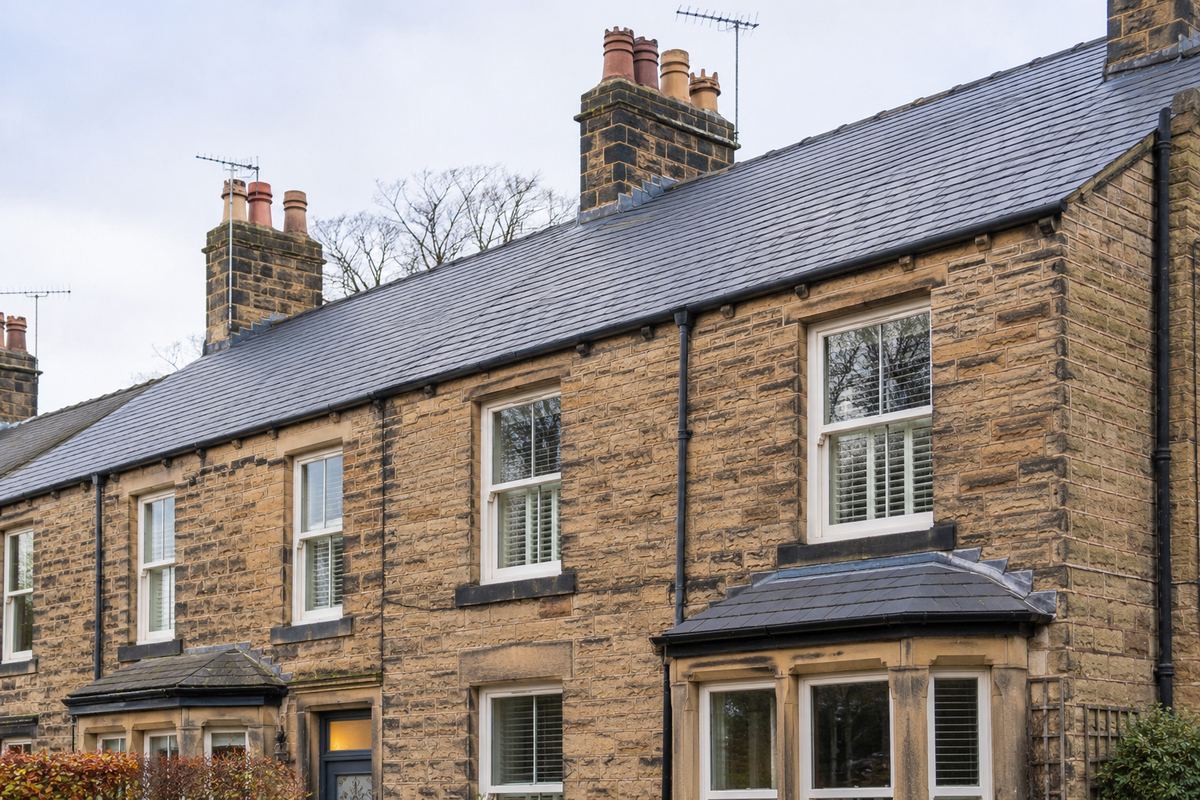
The streets around the centre are full of stone terraces and houses with Welsh slate roofs, shared stacks and dormers. Shops and businesses on the main streets have flats or storage above, with slate roofs to the street and flat roofs at the back. Slipped slates, chimney work and flat roof renewals at the rear are typical.
Victorian villas
Larger Victorian houses on the roads round the park and towards Fulneck have steep slate roofs with valleys, bays and generous lead. Valleys and lead are where they leak, and their stacks need regular care.
Inter-war and post-war Pudsey
Pudsey grew a lot in the twentieth century, with inter-war semis along the main roads and large post-war estates. Hip and ridge tiles on old mortar, porous concrete tiles, brittle felt at the eaves and flat-roofed garages and porches are the usual issues. Many of these roofs are due for their first full replacement.
Weather and access
Pudsey is high and open, particularly towards the Bradford side, and takes westerly gales. Verges and ridges suffer, and driven rain finds gaps. Access ranges from easy driveways to steep terraced streets. Farsley and Calverley are the nearest areas to the north, with Stanningley close by and Horsforth a short drive across the valley.
The houses and roofs of Pudsey
Stone terraces and cottages
Stone-built terraces in Pudsey were roofed with thin blue slate on timber battens, many without any felt underneath. Repairs on a Pudsey row need slate of the same size and careful work at the party line with next door.
Victorian and Edwardian houses
Victorian houses in Pudsey were roofed to last, but a hundred-plus years of weather wears out nails, lead and mortar. On many Pudsey roofs the slate is still good enough to strip and relay.
Inter-war semis
A typical Pudsey semi from the 1930s has a hipped tile roof, a shared stack and a flat or tiled roof over the bay. Where one Pudsey owner has re-roofed and the next has not, the joint at the party wall needs care.
Post-war estates
Estate houses in Pudsey from the post-war decades have plain pitched roofs, flat-roofed porches and stores, and rows of garages. In Pudsey the flat roofs and the verges usually fail first.
What tends to go wrong in LS28
- Slates slipping as old nails rust through
- Shared stacks with tired pointing and lead
- Valleys and hidden gutters overflowing
- Long lead details cracking with age
- Loose hip and ridge tiles on old mortar
- Small bay roofs leaking at the wall
- Concrete tiles gone porous
Want a quick read on a Pudsey roof before anyone visits? The roof health quiz takes a couple of minutes.
Roofing services in Pudsey
Slate & Tile Repairs
Slipped slates refixed, cracked tiles swapped, nail sickness spotted early. Matching sizes and profiles sourced.
More on this →Chimney Repairs
Pointing, flaunching, pots, caps and new lead around the stack, or an unused stack taken down safely.
More on this →Ridge, Verge & Valley
Ridge tiles rebedded or dry-fixed, gable verges renewed, valleys cleared and relined in lead or GRP.
More on this →Lead Flashing
Aprons, step flashings, soakers and back gutters cut into the joint and dressed by hand, not stuck on.
More on this →Fascias & Soffits
Rotten roofline boards stripped back to sound timber and renewed, with eaves vents and gutters refitted.
More on this →Roof Replacement
Stripped, re-membraned, re-battened and relaid in slate or tile when repairs have stopped paying their way.
More on this →Also in Pudsey: roof repairs, leaking roofs, flat roofs, guttering, storm damage.
Roof care through the year in Pudsey
- Autumn: Before the clocks go back is the time to look along the Pudsey roof from the street for anything out of line.
- Winter: Westerly gales push rain under verges and flashings; a leak in Pudsey that only appears in a storm usually starts at an edge.
- Spring: Moss grows quickly through a damp Pudsey spring and can lift tile edges and block gutters by summer.
- Summer: Summer is when most full re-roofs and chimney rebuilds in Pudsey are planned, so the roof is ready for autumn.
How we work in Pudsey
- Found before it is priced: in Pudsey we trace the fault from inside and out before writing anything down, so you pay to fix the cause.
- Repair if it will last: when a roof in Pudsey only needs one slate, one flashing or one ridge put right, that is the job we price.
- Photos of what we see: for work in Pudsey that is out of sight from the ground, you get photos so you can see the problem for yourself.
- Access shown separately: ladders, towers or scaffold for a roof in Pudsey are planned ahead and listed as their own line.
Pudsey is part of the patch we work from Horsforth, so the same people who look at roofs across LS18 come out to Pudsey.
Areas near Pudsey
Around Pudsey there are several other areas with their own pages. Here are the nearest, centre to centre:
- StanningleyLS28 · 1.5 km away
- FarsleyLS28 · 1.5 km away
- BramleyLS13 · 2.1 km away
- RodleyLS13 · 2.5 km away
- CalverleyLS28 · 3.6 km away
- DrighlingtonBD11 · 4.2 km away
Or search every area by town or postcode.
The highlighted pin is Pudsey; the others are the six nearest areas with their own pages. Map data © OpenStreetMap contributors.
Roofing in Pudsey: questions
- Yes. Older buildings like those at Fulneck need matching materials and careful work, and some may be listed. We check what applies before suggesting any change.
- Yes. Rear flat roofs over storerooms are a common leak point. We check the deck, the edges and the joint with the main building, and plan the work around opening hours.
- If the tiles are porous and the felt has failed, replacement is often the best value. We show you what we find before recommending it.
- Yes. Pudsey (LS28) is part of our patch, which spreads out from Horsforth across north-west Leeds and the rest of the district. Every roof in Pudsey is looked at before it is priced, and the price goes in writing.
- For a Pudsey roof, phone the office, use the call-back form on this page or send a photo through the roof photo check. We then look at the Pudsey roof, explain what we find and send a written price with the access listed separately.
- Yes. For lets in Pudsey, access is arranged with the tenants, and the photos and written price go to whoever manages the property.
- Pudsey is covered from Horsforth as part of the same patch, and the distance makes no difference to how the job is looked at or priced. The price for a roof in Pudsey comes from the work and the access it needs, nothing else.