Ridge, Verge & Valley in Horsforth and around
Look along any Horsforth street after a winter of gales and you will see ridge tiles with gaps under them, verges with the mortar washed out and valleys full of moss. These parts of the roof are exposed on two sides, they move with the timbers underneath, and traditionally they rely on sand and cement mortar that cracks and falls out over time.
The ridge caps the very top of the roof. Verges finish the sloping edges at the gable ends. Valleys are the channels where two slopes meet at an internal corner, common on the bay-fronted villas and larger detached houses around Cragg Wood, Hall Park and the roads off Long Row. Each needs a different repair, but all three are about keeping wind and water from getting under the covering.
Modern dry-fix systems hold ridge and verge tiles mechanically, without relying on mortar alone, and they are now the usual standard on new work. On older or more traditional houses, rebedding in a well-mixed mortar is often the better match. We explain which suits your roof and why.
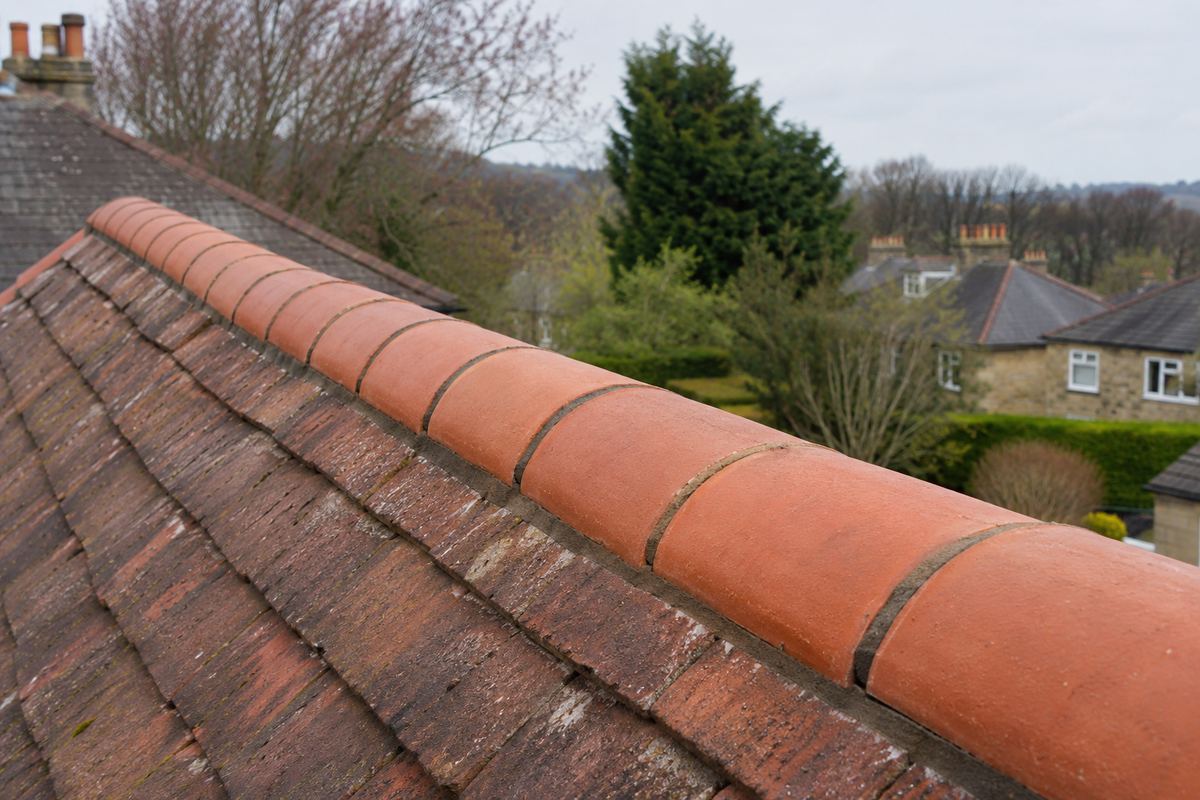
Signs your ridge, verge or valley needs work
- Gaps under ridge tiles, or a ridge tile that rocks or has moved
- Lumps of mortar in the gutter or on the path below the gable
- Bare edges at the gable where the mortar has fallen out from under the slates
- Moss and leaves sitting in a valley, or water spilling over its edges
- A crack or hole in a lead valley lining, or slipped valley tiles
- A damp patch inside near the top of a gable wall
- Daylight under the ridge when seen from the loft
- Birds getting in under the verge or the ridge end
Why these parts of the roof fail
Mortar wear
Sand and cement mortar is strong but brittle. Daily temperature changes and frost crack it, and once it has cracked, rain washes it out and the ridge or verge tiles lose their grip.
Wind
Gables and ridges catch the wind first. A ridge tile with weak bedding can be lifted off in a gale, and the ones next to it soon follow.
Valley blockages
Trees near the house fill valleys with leaves and seeds. When the valley cannot drain, water backs up under the slates either side.
Cracked or undersized lead
Old valley linings can crack along their length or at the joins, especially if the pieces were too long or fixed too tightly to move.
Settlement
As the roof timbers settle over the years, the line of the ridge can dip and move, opening joints between the ridge tiles.
How the work is done
1. Assess
We check the bedding, the tiles, the lead and the timbers underneath where we can see them. Cracked ridge tiles are noted so they can be matched or replaced.
2. Strip the failing section
Loose ridge or verge tiles are lifted, old mortar is cleaned off, and any rotten timber at the gable or ridge board is reported before we go further.
3. Rebed or dry-fix
Ridges are rebedded on fresh mortar with the joints filled, or fitted with a dry-fix system that screws each tile to the ridge board. Verges are repointed or fitted with dry verge units.
4. Renew valleys
Lead valleys are relined with the right thickness of lead in sensible lengths, or fibreglass valley troughs are fitted where they suit the roof. Valley slates are cut and fixed so the water channel stays open.
5. Tidy and check
Mortar spills are cleaned from the slates, gutters are cleared, and the finished work is photographed so you can see it.
Wet bedding or dry-fix?
| Traditional mortar | Dry-fix ridge and verge | |
|---|---|---|
| How it holds | Mortar bed and pointing | Mechanical clips and screws |
| Best suited to | Older houses, conservation areas, matching neighbours | Most modern tiles, exposed gables, new roofs |
| Upkeep | Pointing may need attention over the years | Very little once fitted |
| Appearance | Traditional mortar line | Neat plastic or tile-coloured caps at verges |
Not sure what is on your roof? A photo from the street is usually enough for us to tell you.
Worth knowing
Building regulations
Current standards expect ridge and verge tiles to be fixed mechanically rather than with mortar alone. On repairs we follow that where it suits the roof, and we tell you what we propose.
Matching ridge tiles
Half-round and angled ridge tiles come in many sizes and colours. If yours are an older pattern, reclaimed tiles often give the closest match.
Bigger houses, more valleys
The large Victorian houses in Cragg Wood and around Hall Park often have several valleys and hidden gutters. Each one is a place to check whenever work is done on the roof.
Combine the work
If a scaffold is up for the ridge, it is usually worth checking the chimney and the gutters at the same time, so the access cost is only paid once.
Related roofing work
Roof Repairs
One weak point found and put right: slates, ridges, lead or flat roof, matched to what is already on the house.
More on this →Slate & Tile Repairs
Slipped slates refixed, cracked tiles swapped, nail sickness spotted early. Matching sizes and profiles sourced.
More on this →Storm Damage
After a westerly gale: made weathertight first, then ridges, verges, lead and edges repaired properly.
More on this →Lead Flashing
Aprons, step flashings, soakers and back gutters cut into the joint and dressed by hand, not stuck on.
More on this →Where we do this
Horsforth first, then everywhere else in the Leeds district. Nearby area pages where this comes up a lot: Horsforth, Rawdon, Cookridge, Bramhope, Yeadon, Guiseley, Adel, Holt Park. Anywhere else: put your town or postcode into the area finder.
Ridge, Verge & Valley: questions people ask
- On most concrete tile roofs dry-fix is the better long-term option and is now the normal standard. On slate roofs on older houses, or where the neighbours' roofs show a traditional mortar line, rebedding may suit better. We recommend one once we have seen the roof.
- A typical terrace or semi ridge is usually a day's work once access is in place, depending on the weather and how much old mortar has to be removed.
- Often it just needs clearing, and that is worth doing first. If it still overflows when clean, the lining may be too narrow, cracked or laid with too little fall, and that needs relining.
- Yes, if the tile can be matched and the tiles either side are still well bedded. If the bedding under the neighbouring tiles is weak too, we suggest doing the whole run so the next gale does not take another.
- They come in colours to suit most roofs and are neat from the street. On a house in a conservation area or with traditional neighbours, a mortar verge can still be the better look.