Roof Repairs in Horsforth and around
Horsforth has almost every kind of roof Leeds builds. Stone terraces off Town Street with Welsh slate, inter-war semis along the ring road with clay or concrete tiles, 1960s and 70s estates with interlocking concrete, the big Victorian houses in Cragg Wood with their valleys and dormers, and new estates with modern tiles and dry ridges. Each has its own habits, and a repair only lasts if it is done in a way that suits the roof it is on.
A repair starts with finding the fault, and that is not always where the water shows. Rain can run along a batten, down a rafter or across the top of a ceiling before it drips, so a stain over the landing may begin a metre or two away. We look from the ground and from inside first, then from a ladder or the roof itself where it is safe, and only then say what needs doing.
If the roof is sound apart from one problem, that problem is what you get a price for. If we find that the slates are failing across a whole slope, or the battens have rotted, we show you photos and explain why patching would only move the leak along. Either way the price is written down before any work starts.
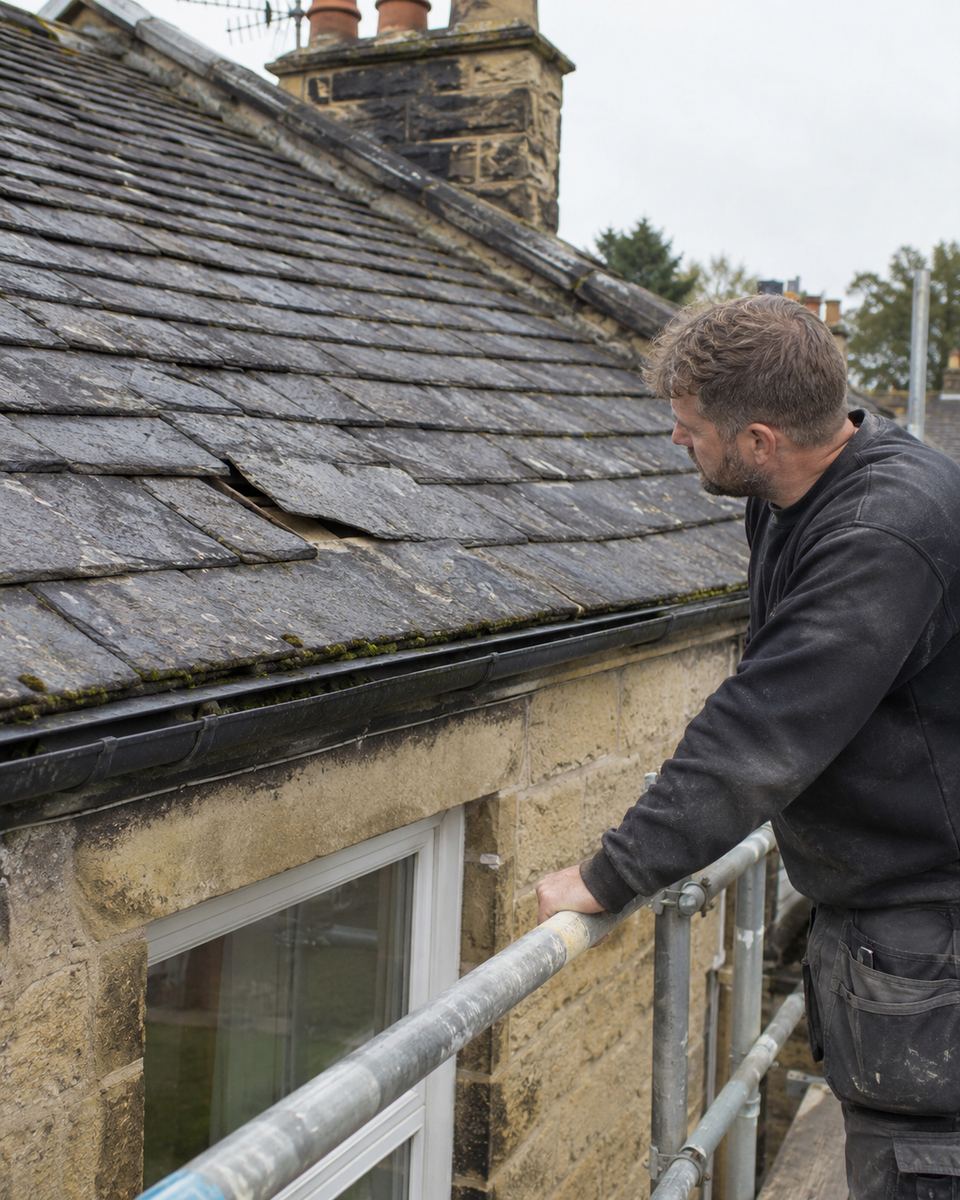
Signs your roof needs a repair
- A slate or tile lying in the garden, on the path or in the gutter
- A gap in a row of slates you can see from across the road
- A damp patch on a bedroom ceiling that grows after wind-driven rain
- Daylight through the roof boards or felt when you look in the loft
- Mortar from the ridge or the gable end sitting in the gutter
- A drip or tide mark on a chimney breast in an upstairs room
- Lead at the chimney or a wall that has lifted, split or come away
- Felt under the tiles that has sagged and holds water at the eaves
What usually causes a roof to need repairing
Nail sickness on older slate roofs
Slates on Horsforth's older houses were fixed with iron nails. Over many decades the nails rust through and the slates slide out of line one by one. A few can be refixed with copper or aluminium tingles; when it is happening across a whole slope, the nails are telling you the roof is due a strip and relay.
Wind getting under edges
Ridges, verges and the top course of tiles take the full force of a westerly gale. Once the mortar holding them has crumbled, wind can lift them away. Horsforth sits high on the side of the Aire valley, and the houses facing west and north-west take most of it.
Failed or missing lead
Lead flashings around chimneys, dormers and abutment walls last a long time when they are dressed and fixed correctly. When they have been fixed with sealant instead of being tucked into the brick or stone joint, they open up within a few winters.
Blocked gutters and valleys
Moss, leaves and silt hold water where the roof should be shedding it. A blocked valley sends rain sideways under the tiles, and an overflowing gutter soaks the wall and the ends of the rafters.
Earlier patch repairs
Bitumen paint on slates, foam in the gaps and sealant along ridges trap water and hide the real fault. Part of most repairs is taking these off so we can see what is underneath.
How a roof repair is done
1. Find the fault
We check inside and outside, follow the water route back to where it enters, and look at the rest of the roof while we are there so you know its general condition.
2. Price it in writing
You get a written price for the repair, with the access needed shown on its own line. If the roof needs a scaffold or a tower for safe working, we say so and why.
3. Make it safe
Ladders are footed and tied, roof ladders are used on slopes, and anything above the eaves that cannot be reached safely from a ladder is done from a tower or scaffold.
4. Carry out the repair
Slates are refixed or replaced with matching sizes, tiles are swapped for the same profile, ridge and verge mortar is renewed or a dry-fix system fitted, and lead is cut into the joint, dressed and clipped.
5. Leave it clear
Gutters and valleys near the repair are cleared, broken pieces are taken away, and you are shown what was done, with photos if the work was out of sight.
Worth knowing
Matching old slates
Many Horsforth terraces and villas have Welsh slate in sizes that are no longer cut new. Reclaimed slate of the right size and thickness is usually the best match on a repair, and we say in the price whether new or reclaimed is being used.
Conservation areas
Parts of Horsforth, Rawdon and Calverley are conservation areas. Like-for-like repairs normally need no permission, but changing a material or the look of a roof may. If that applies, we point it out before you decide.
Party walls and shared roofs
On terraces and semis the roof often runs straight on to next door's. A repair near the party line can mean lifting a slate or two on their side, so it helps to tell your neighbour before the day.
When a repair is not worth it
If a roof has slipped slates in several places, broken battens and tired felt, repeated repairs cost more over a few years than relaying the slopes that are failing. We tell you when we think that point has been reached.
Related roofing work
Leaking Roofs
Water runs before it drips. We follow it back from the stain to where it really gets in, then fix that.
More on this →Slate & Tile Repairs
Slipped slates refixed, cracked tiles swapped, nail sickness spotted early. Matching sizes and profiles sourced.
More on this →Ridge, Verge & Valley
Ridge tiles rebedded or dry-fixed, gable verges renewed, valleys cleared and relined in lead or GRP.
More on this →Chimney Repairs
Pointing, flaunching, pots, caps and new lead around the stack, or an unused stack taken down safely.
More on this →Where we do this
Horsforth first, then everywhere else in the Leeds district. Nearby area pages where this comes up a lot: Horsforth, Rawdon, Cookridge, Kirkstall, Yeadon, Bramley, Calverley, Headingley. Anywhere else: put your town or postcode into the area finder.
Roof Repairs: questions people ask
- Yes. Single slates are replaced by sliding the new one into place and holding it with a tingle or a hook, which is normal good practice on a pitched slate roof. If we find more loose slates nearby while we are up there, we tell you before doing anything extra.
- By following the water. Stains, wet timbers in the loft, staining on the felt and the position of nearby chimneys, valleys and flashings all narrow it down. On some roofs a hose test on one section at a time confirms the entry point.
- Not always. Low eaves and a single-storey roof can often be done from ladders. Work on a high ridge, a chimney or the front of a three-storey terrace usually needs a tower or scaffold to be done safely. The written price shows which and why.
- We use the same type and size of slate or the same tile profile wherever we can get it. New slate can look slightly darker for a while; reclaimed slate usually blends in straight away.
- Most repairs can be done in any season on a dry day. Mortar work needs temperatures above freezing, and lead and felt work is best done in the dry, so we plan around the forecast and keep you informed if a day has to move.