Leaking Roofs in Horsforth and around
A roof leak is worrying because you cannot see the cause. All you have is a stain, a drip into a bucket or a damp smell in the loft. The first job is working out which part of the roof the water is entering through, and that means looking at the roof as a whole: the slates or tiles, the ridge, the chimney and its lead, any valleys, dormers and roof windows, the gutters and the flat roofs that join the main slope.
On Horsforth houses the most common culprits are the chimney, the lead where a roof meets a higher wall, blocked valleys on bigger houses, and old felt-covered flat roofs over kitchens and garages. Wind-driven rain from the west also finds its way under verges and through slipped slates on exposed gables, especially on the higher streets towards Cragg Hill and Brownberrie.
Not every damp patch is a roof leak. Condensation in a cold loft, a leaking pipe or tank, or water tracking through a cracked render can all look similar from inside. We check for those too, so you are not paying for a roof repair that does not solve anything.
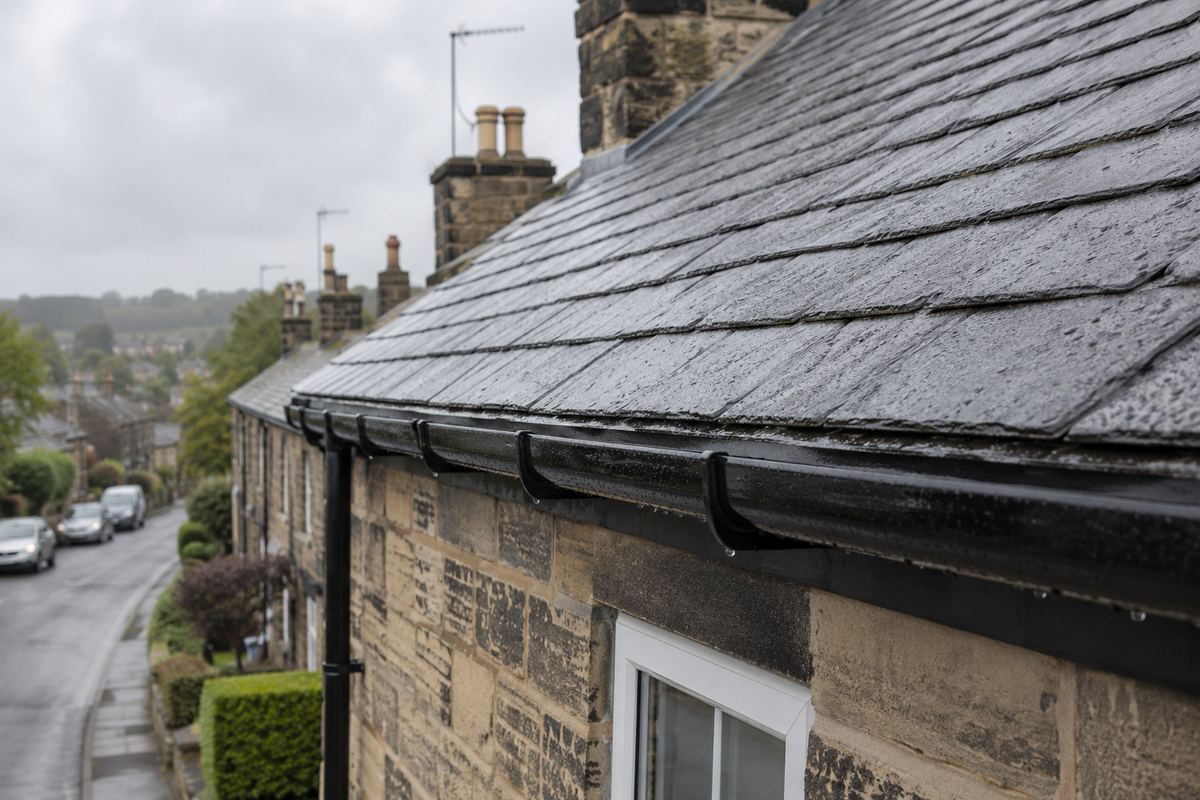
How a roof leak shows itself
- A brown ring on a ceiling that grows a little after each heavy rain
- Drips into the loft, onto boxes stored up there or into the insulation
- A damp stripe running down a chimney breast in an upstairs room
- Bubbling paint or loose plaster on the top of an inside wall
- A musty smell in a bedroom that is worse in wet weather
- Wet or stained rafters and roof boards when you look up from the loft hatch
- Water on a windowsill below a dormer or roof window
- A drip inside a garage or extension with a flat roof
Where roof leaks usually start
Chimneys
A chimney passes straight through the roof, so it relies on lead flashing, sound pointing and a good top to keep water out. Cracked flaunching, open joints or a lifted flashing are among the most common leaks we find on Horsforth's older houses.
Abutments and side walls
Where a roof meets a higher wall, such as a house next door, a two-storey gable or a dormer cheek, step flashings and soakers carry the water away. When they are missing or fixed only with mastic, rain runs into the wall and the ceiling below.
Valleys
The inside corner where two slopes meet collects all the water from both. If the lead or valley tiles are cracked, or the valley is blocked with moss and leaves, water backs up under the slates.
Slipped or broken slates and tiles
A single slate out of line lets rain onto the felt below. Old felt can be brittle or torn, so the water gets through to the timber and the ceiling.
Flat roof junctions
Many leaks blamed on the main roof are actually at the joint between a flat roof and the house wall, or at the edge of a dormer. We check the flat roof as well as the slope above it.
How we trace and fix a leak
1. Ask questions
When does it leak: every time it rains, or only in strong wind from one direction? How long has it been happening? The answers point us towards the cause before we arrive.
2. Look inside
From the loft we can often see the wet timber, the stain on the felt and the line the water has taken. That narrows the search outside to a small area.
3. Look outside
From the ground, a ladder or the roof itself, we check the slates or tiles, the lead, the chimney, the valleys and the gutters in that area, and anything else that could be feeding the water.
4. Set out the repair
You get a written description of the cause and the repair, with photos where we can take them, and the price before anything is done.
5. Fix and check
After the repair we check the area again and, where it helps, run water over it to make sure the route is closed.
Worth knowing
Keeping it under control
Until it is fixed, put a bucket or tray under the drip, move anything you value out of the way and, if a ceiling is bulging, keep away from it and switch off lights in that room. Please do not go onto the roof yourself.
Leaks that come and go
A leak that only shows in a south-westerly gale is usually wind-driven rain getting under a verge, a slate or a flashing. These are harder to find, so we may ask you to note the weather each time it happens.
Keep a note
Take photos of the stain each time it grows and jot down the date and the weather. Keep any slates that come down. It all helps narrow down the cause, and you have a record of what happened.
Condensation or a leak?
Damp that appears on cold mornings, on the underside of the felt all over, or on nails across the whole loft is often condensation rather than a leak. Better loft ventilation is the cure, not roof repairs.
Related roofing work
Roof Repairs
One weak point found and put right: slates, ridges, lead or flat roof, matched to what is already on the house.
More on this →Chimney Repairs
Pointing, flaunching, pots, caps and new lead around the stack, or an unused stack taken down safely.
More on this →Lead Flashing
Aprons, step flashings, soakers and back gutters cut into the joint and dressed by hand, not stuck on.
More on this →Flat Roofs
Garages, kitchen extensions, dormers and bays repaired or renewed in EPDM, GRP fibreglass or reinforced felt.
More on this →Where we do this
Horsforth first, then everywhere else in the Leeds district. Nearby area pages where this comes up a lot: Horsforth, Rawdon, Yeadon, Guiseley, Kirkstall, Headingley, Farsley, Adel. Anywhere else: put your town or postcode into the area finder.
Leaking Roofs: questions people ask
- As soon as you reasonably can. A slow leak wets insulation, timber and plaster, and the longer it runs the more there is to dry out and replace. Phone the office, describe what you are seeing and we will arrange a time to look.
- Usually, yes, though it can take a little longer. Knowing the wind direction and the kind of rain when it leaks is a big help. If the cause is not obvious, we may test sections of the roof with water to narrow it down.
- If the damp shows on or next to a chimney breast, the chimney is the first suspect: the flashing, the pointing, the flaunching or an open pot. But slates and valleys next to the stack can also feed water to the same spot, so we check all of it.
- That line is the joint between the flat roof and the house. The upstand may have shrunk back, the flashing above it may have lifted, or water may be running down the wall from the roof above. It is one of the most common leaks we see.
- If there is a loft hatch we can reach safely, it helps. Looking at the underside of the roof often shows exactly where water is getting in.