Roofs in Farsley
Farsley sits between Pudsey, Calverley and Rodley in west Leeds. Its Town Street keeps a village feel, with Sunny Bank Mills, the former woollen mill now home to studios and businesses, and a statue of Samuel Marsden, who was born in the village. Much of the centre is a conservation area.
Stone terraces
Most of Farsley's older houses are stone terraces built for mill workers, with Welsh slate roofs, shared chimneys and, often, dormers. The slates outlast their iron nails, so slipped slates are common, and chimneys need pointing and lead work over time.
On a terrace, the roof is shared at the party wall, so repairs near the party line may affect next door. We point that out and suggest a word with the neighbour before the work is booked.
Mill buildings and conversions
Old mill and industrial buildings in and around Farsley have large slate roofs with valleys and long gutters. Some are now flats or workspaces. On these, the gutters and valleys are where problems start, and access needs proper planning.
Semis, bungalows and newer houses
Around the older streets there are inter-war and post-war semis, bungalows, and newer closes on former industrial land. Hip and ridge work, verge repairs, flat roof renewals and the occasional full re-roof are typical. Newer houses need small repairs to dry verges, ridges and canopies.
Farsley is on the side of the valley, and the higher streets catch the westerly weather. Access is usually from the street, with towers on steep pavements set level carefully. Calverley, Rodley and Pudsey are the nearest areas, with Horsforth across the river.
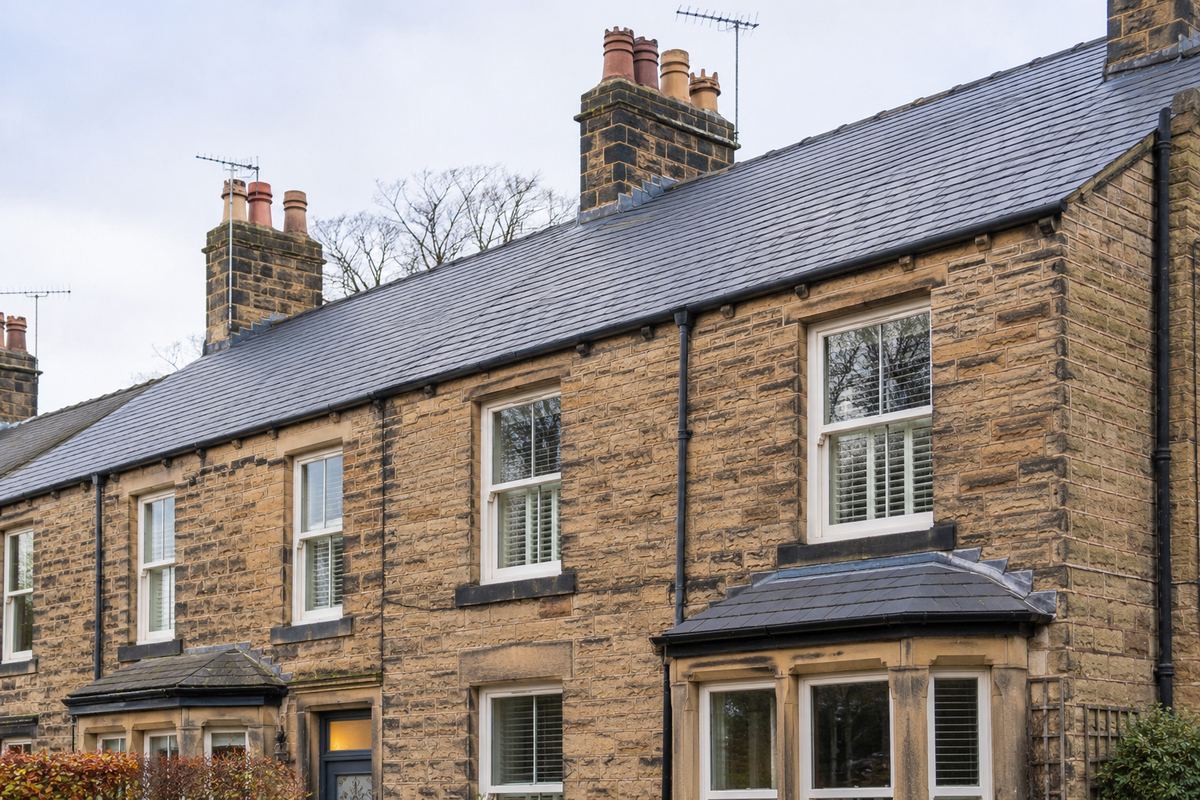
The houses and roofs of Farsley
Stone terraces and cottages
The gritstone and sandstone rows of Farsley mostly carry Welsh slate, often with a shared chimney stack every two houses. On a Farsley terrace, the slates are usually sound long after the iron nails holding them have rusted away.
Flats and apartment blocks
Blocks of flats in Farsley, from low-rise maisonettes to converted buildings, have shared roofs managed by landlords or agents. Work on a Farsley block is planned around residents and safe access.
Inter-war semis
Semis from between the wars line the main roads of Farsley, with tiled roofs, rendered or pebble-dashed upper walls and timber fascias. In Farsley, the roofline boards and the bay tops tend to need attention before the main roof does.
Newer estates
Recent houses around Farsley have plenty of small details: canopies, dormers, valleys and dry verge units. In Farsley those details, not the main slopes, are where most faults appear.
What tends to go wrong in LS28
- Slates slipping as old nails rust through
- Shared stacks with tired pointing and lead
- Blocked outlets behind parapets
- Long gutters on shared roofs
- Loose hip and ridge tiles on old mortar
- Small bay roofs leaking at the wall
- Dry verge caps working loose
A photo of your Farsley roof taken from the pavement or the garden is often enough for a first opinion: use the photo check.
Roofing services in Farsley
Slate & Tile Repairs
Slipped slates refixed, cracked tiles swapped, nail sickness spotted early. Matching sizes and profiles sourced.
More on this →Chimney Repairs
Pointing, flaunching, pots, caps and new lead around the stack, or an unused stack taken down safely.
More on this →Guttering
Overflows, dripping joints and sagging runs sorted. Cast iron repaired or renewed, uPVC refitted to fall.
More on this →Flat Roofs
Garages, kitchen extensions, dormers and bays repaired or renewed in EPDM, GRP fibreglass or reinforced felt.
More on this →Ridge, Verge & Valley
Ridge tiles rebedded or dry-fixed, gable verges renewed, valleys cleared and relined in lead or GRP.
More on this →Fascias & Soffits
Rotten roofline boards stripped back to sound timber and renewed, with eaves vents and gutters refitted.
More on this →Also in Farsley: roof repairs, leaking roofs, lead flashing, storm damage, roof replacement.
Roof care through the year in Farsley
- Autumn: Autumn in Farsley is when blocked outlets and gutters start sending water down walls rather than pipes.
- Winter: Snow sitting on a Farsley roof melts from the warm side first, and the meltwater finds any weak gutter joint.
- Spring: Moss grows quickly through a damp Farsley spring and can lift tile edges and block gutters by summer.
- Summer: Summer is when most full re-roofs and chimney rebuilds in Farsley are planned, so the roof is ready for autumn.
How we work in Farsley
- Found before it is priced: in Farsley we trace the fault from inside and out before writing anything down, so you pay to fix the cause.
- Repair if it will last: when a roof in Farsley only needs one slate, one flashing or one ridge put right, that is the job we price.
- Photos of what we see: for work in Farsley that is out of sight from the ground, you get photos so you can see the problem for yourself.
- Materials that match: slate, tile and ridge on a Farsley house are matched by size and profile, new or reclaimed.
Farsley is part of the patch we work from Horsforth, so the same people who look at roofs across LS18 come out to Farsley.
Areas near Farsley
Next door to Farsley: the closest area pages, nearest first.
- PudseyLS28 · 1.5 km away
- RodleyLS13 · 1.9 km away
- StanningleyLS28 · 2.1 km away
- CalverleyLS28 · 2.2 km away
- BramleyLS13 · 2.7 km away
- HawksworthLS5 · 4.8 km away
Or search every area by town or postcode.
The highlighted pin is Farsley; the others are the six nearest areas with their own pages. Map data © OpenStreetMap contributors.
Roofing in Farsley: questions
- The centre is. Like-for-like repairs are usually fine; changes to materials or to the look of a roof may need permission. We tell you if we think it applies.
- If slates are slipping in different places every year and the nails are rusted, it may be. Sound slates can often be reused on a relay, which keeps the look and reduces cost.
- Yes. We deal with the freeholder or managing agent and send photos and a written price.
- Yes. Farsley (LS28) is part of our patch, which spreads out from Horsforth across north-west Leeds and the rest of the district. Every roof in Farsley is looked at before it is priced, and the price goes in writing.
- For a Farsley roof, phone the office, use the call-back form on this page or send a photo through the roof photo check. We then look at the Farsley roof, explain what we find and send a written price with the access listed separately.
- Yes. A photo taken from the street, the garden or a window gives a good first idea of what is going on with a Farsley roof. It cannot show the felt or timbers under a Farsley roof, so the written price follows a proper look.
- Yes. For lets in Farsley, access is arranged with the tenants, and the photos and written price go to whoever manages the property.