Roofs in Stanningley
Stanningley lies on the high ground between Bramley and Pudsey, along the old Leeds to Bradford road, with New Pudsey station and the ring road nearby. It has a long industrial history, and its older streets are lined with stone terraces built for the mills and foundries.
The stone terraces have Welsh slate roofs, shared stacks and dormers. Slates slip as their nails rust, chimneys need repointing and new lead, and dormers leak at the cheeks. Shops along the main road have flats above and flat roofs behind.
Beyond the old centre there are inter-war and post-war semis and terraces with tile roofs, many needing ridge and verge repairs or full replacement. Flat-roofed porches, garages and extensions are common.
Stanningley is exposed on the ridge, and westerly gales find loose ridges and verges. Access ranges from tight terraced streets to easy driveways. Bramley and Pudsey are on either side, with Farsley to the north and Horsforth a short drive away.
Many Stanningley terraces sit tight against the pavement on a hill, so a street-side slate repair usually means a tower levelled on the slope or a short scaffold licence from the council. Rear roofs are often easier, reached from yards that open onto a back lane.
Where an old stone terrace has been extended with a flat-roofed kitchen, the joint with the stone wall is the usual leak point. We cut the flashing into a sound joint rather than gluing it to the face, because rain runs down Pennine stone and straight behind anything stuck on.
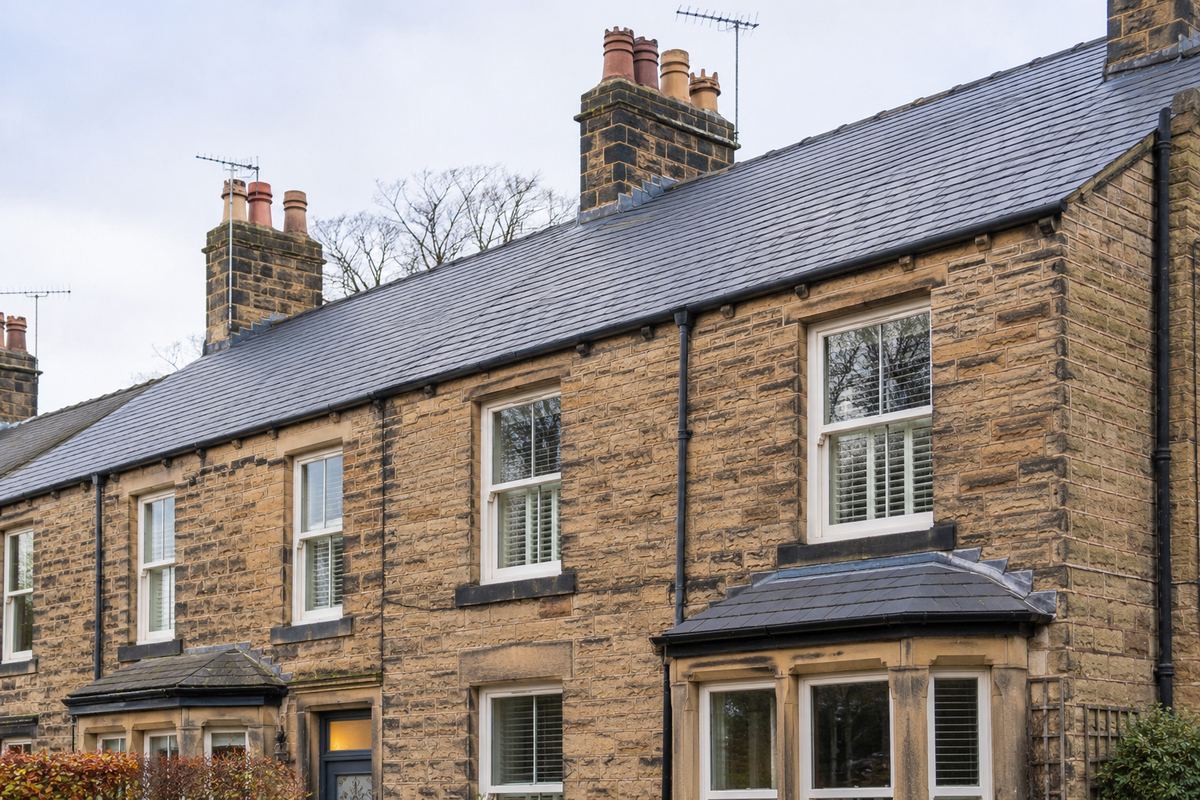
The houses and roofs of Stanningley
Stone terraces and cottages
Older stone cottages around Stanningley sit low and solid, with heavy stacks and slate or stone-slate roofs. Water on a Stanningley cottage tends to get in at the chimney or the back wall rather than through the middle of the slope.
Post-war estates
Houses from the 1950s and 60s in Stanningley often have bitumen felt under the tiles that has become brittle at the eaves. Water in Stanningley then runs behind the gutter and into the fascia.
Shops and flats above
Buildings on the main street of Stanningley often mix a pitched front roof with a flat roof behind. The joint between the two is a common Stanningley leak point.
What tends to go wrong in LS28
- Slates slipping as old nails rust through
- Shared stacks with tired pointing and lead
- Concrete tiles gone porous
- Brittle felt at the eaves
- Rear flat roofs over storerooms
- Hidden valley gutters
- Roofline boards rotting behind old paint
Want a quick read on a Stanningley roof before anyone visits? The roof health quiz takes a couple of minutes.
Roofing services in Stanningley
Slate & Tile Repairs
Slipped slates refixed, cracked tiles swapped, nail sickness spotted early. Matching sizes and profiles sourced.
More on this →Chimney Repairs
Pointing, flaunching, pots, caps and new lead around the stack, or an unused stack taken down safely.
More on this →Roof Replacement
Stripped, re-membraned, re-battened and relaid in slate or tile when repairs have stopped paying their way.
More on this →Flat Roofs
Garages, kitchen extensions, dormers and bays repaired or renewed in EPDM, GRP fibreglass or reinforced felt.
More on this →Leaking Roofs
Water runs before it drips. We follow it back from the stain to where it really gets in, then fix that.
More on this →Roof Repairs
One weak point found and put right: slates, ridges, lead or flat roof, matched to what is already on the house.
More on this →Also in Stanningley: ridge, verge & valley, lead flashing, guttering, fascias & soffits, storm damage.
Roof care through the year in Stanningley
- Autumn: Autumn in Stanningley is when blocked outlets and gutters start sending water down walls rather than pipes.
- Winter: Frost splits porous tiles and loosens old mortar on ridges and verges, so loose pieces often show up on Stanningley paths in January and February.
- Spring: Moss grows quickly through a damp Stanningley spring and can lift tile edges and block gutters by summer.
- Summer: Hot weather shows up a tired felt flat roof in Stanningley: it softens, blisters and the cracks open wider.
How we work in Stanningley
- Found before it is priced: in Stanningley we trace the fault from inside and out before writing anything down, so you pay to fix the cause.
- Repair if it will last: when a roof in Stanningley only needs one slate, one flashing or one ridge put right, that is the job we price.
- Access shown separately: ladders, towers or scaffold for a roof in Stanningley are planned ahead and listed as their own line.
- Materials that match: slate, tile and ridge on a Stanningley house are matched by size and profile, new or reclaimed.
The patch spreads out from Horsforth across the north-west of Leeds, and Stanningley is covered the same way as the streets closest to home.
Areas near Stanningley
Next door to Stanningley: the closest area pages, nearest first.
- BramleyLS13 · 0.7 km away
- PudseyLS28 · 1.5 km away
- RodleyLS13 · 1.7 km away
- FarsleyLS28 · 2.1 km away
- HawksworthLS5 · 3.2 km away
- KirkstallLS5 · 3.3 km away
Or search every area by town or postcode.
The highlighted pin is Stanningley; the others are the six nearest areas with their own pages. Map data © OpenStreetMap contributors.
Roofing in Stanningley: questions
- It is normal for houses of that age. The roof stays sound as long as the slates stay in place. When it is eventually relaid, a breathable membrane goes in.
- Yes. Stanningley shop roofs get the deck, the edges and the joint with the main building checked, with the work timed around trading hours.
- Yes. Stanningley (LS28) is part of our patch, which spreads out from Horsforth across north-west Leeds and the rest of the district. Every roof in Stanningley is looked at before it is priced, and the price goes in writing.
- Yes. A photo taken from the street, the garden or a window gives a good first idea of what is going on with a Stanningley roof. It cannot show the felt or timbers under a Stanningley roof, so the written price follows a proper look.
- Yes. For lets in Stanningley, access is arranged with the tenants, and the photos and written price go to whoever manages the property.
- All of it, in Stanningley as anywhere else: repairs to slates and tiles, leaks, ridges, verges and valleys, chimneys, lead, flat roofs, gutters, fascias and soffits, storm damage and full re-roofs. The services listed on this Stanningley page link to the detail for each.