Slate & Tile Repairs in Horsforth and around
The slope of a pitched roof is only as good as its weakest slate. When one slides down out of its row, rain gets onto the felt beneath; when the felt is old or missing, it goes straight through to the battens and ceiling. Replacing slipped or broken slates and tiles is one of the most common jobs on north-west Leeds houses, and one of the most useful, because it stops damage spreading.
Horsforth's older terraces and villas are mostly roofed in Welsh blue slate, some with stone slate on the oldest cottages. The inter-war semis often have machine-made clay plain tiles or early concrete tiles, and the post-war estates around Low Lane, Newlaithes and the Horsforth Vale side mostly have concrete interlocking tiles. A good repair uses the same material and the same size, and the right fixing for it.
When we look at a slipped slate we also look at why it slipped. If the nails have rusted, the slates around it will follow. If a batten has rotted, the problem is underneath. That way you know whether you are looking at a one-off repair or the early signs of a roof that needs relaying.
Signs of slate and tile trouble
- A slate hanging lower than its neighbours or sticking out of the row
- A tile with a crack across it or a corner missing
- Pieces of slate or tile on the path, drive or garage roof
- A row of slates looking wavy or uneven from the street
- Copper or lead strips (tingles) visible on several slates: past repairs
- Daylight through the slates when you look in the loft
- Moss growing thickly between tiles and lifting their edges
- A gap at the eaves where the bottom course has slid
Why slates and tiles fail
Rusted nails
Iron nails used on many older Leeds roofs rust slowly over decades. When enough have gone, slates slide one at a time, usually starting where the roof gets the most weather.
Frost
Water soaks into old clay tiles and porous slates, freezes, and splits them. Tiles on north-facing slopes, which stay damp longest, tend to go first.
Wind uplift
A strong gust can lift a loose slate or tile clean off, especially near the ridge and verges and on roofs without mechanical fixings on every tile.
Foot traffic and impacts
Aerial and satellite fitters, window cleaners and earlier roofers walking on slates can crack them. Falling branches do the same in storms.
Rotten battens
If the timber battens holding the slates have softened, nails pull out. This is usually found on roofs where the felt has failed and water has been getting in for a long time.
How we repair slates and tiles
1. Check the roof around the fault
We look along the row and across the slope for loose slates, rusted nails and other cracked tiles, so the price covers what is actually needed.
2. Source a match
We match size, thickness, colour and profile. Welsh slate and common concrete tile profiles are usually easy to find; older clay tiles and unusual slate sizes may mean reclaimed stock.
3. Remove the broken piece
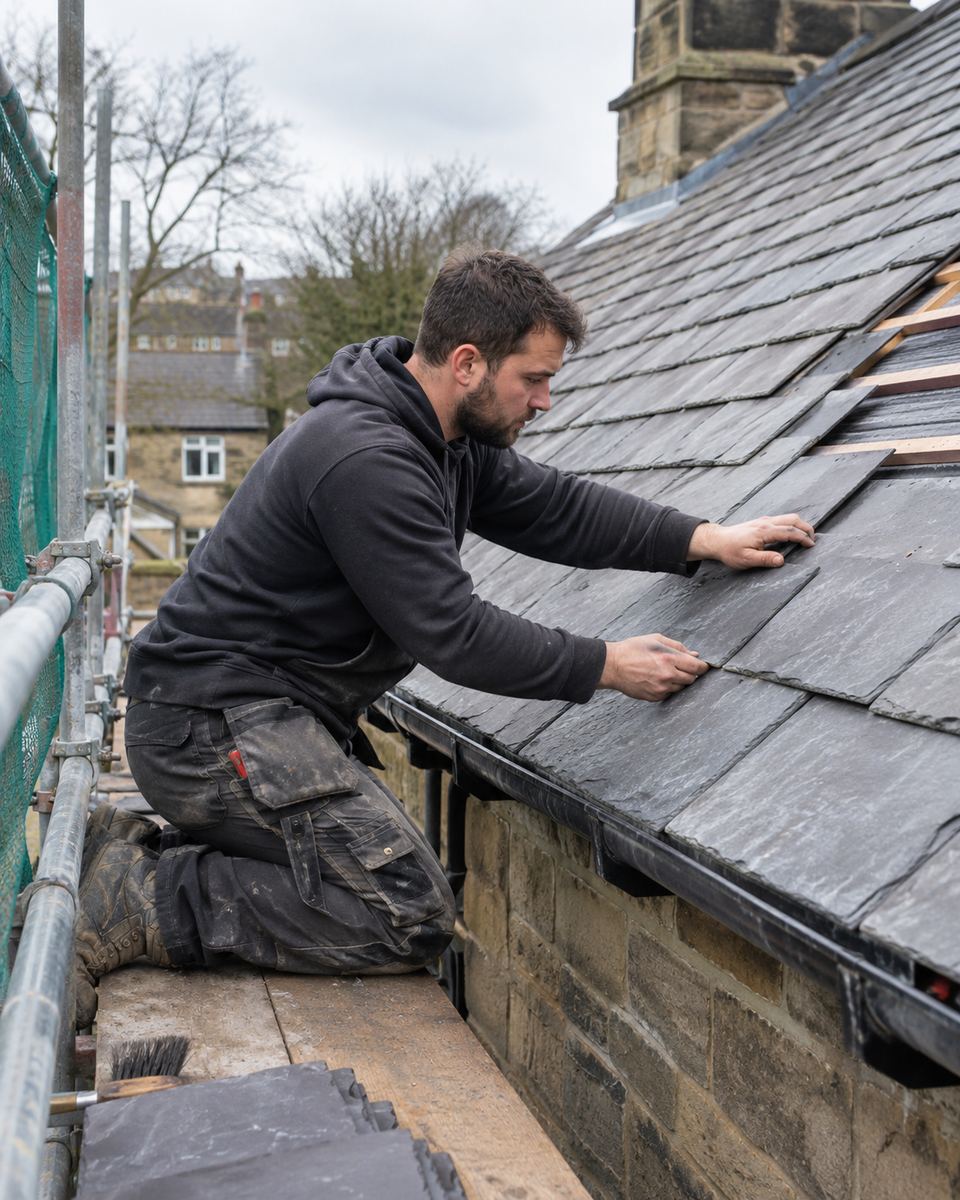
Damaged slates are cut out with a slate ripper so the nails holding them are removed without disturbing the slates either side.
4. Fit the replacement
The new slate is held with a copper or aluminium tingle or a stainless hook. Tiles are hung on their nibs and nailed or clipped where required.
5. Check the felt and battens
If we can see the felt and battens through the gap, we check them. Torn felt can sometimes be patched; rotten battens are a bigger job and are priced separately.
Common Horsforth roof coverings at a glance
| Welsh slate | Clay tiles | Concrete interlocking tiles | |
|---|---|---|---|
| Where you find it | Stone terraces, Victorian villas, cottages | Inter-war semis, some Edwardian houses | Post-war estates, 1960s to 1990s houses, many re-roofs |
| Usual failure | Rusted nails, slipping | Frost cracking, broken nibs | Lifting in wind, cracked corners |
| Repair method | Slate ripper, tingle or hook | Lift and rehang, nail or clip | Lift and rehang, clip |
| Matching | Reclaimed often best | Reclaimed or close new match | Usually a current profile |
Not sure what is on your roof? A photo from the street is usually enough for us to tell you.
Worth knowing
Tingles are normal
The thin strip of lead or copper you see at the bottom of a repaired slate is the standard way to hold a replacement on a roof that is otherwise sound. A few are fine; dozens across a slope suggest the roof is near the end of its life.
Do not paint over it
Coatings sprayed or painted onto slates can stop them drying out and make later repairs, and any future re-roof, harder and more expensive.
Asbestos cement slates
Some 1970s and 1980s roofs use fibre cement slates that may contain asbestos. They are handled differently, and we tell you if we think yours could be one.
Ask about the felt
On older roofs there may be no felt at all, or only bitumen felt that has become brittle. That changes how long a slate repair will hold, so we mention it.
Related roofing work
Roof Repairs
One weak point found and put right: slates, ridges, lead or flat roof, matched to what is already on the house.
More on this →Ridge, Verge & Valley
Ridge tiles rebedded or dry-fixed, gable verges renewed, valleys cleared and relined in lead or GRP.
More on this →Storm Damage
After a westerly gale: made weathertight first, then ridges, verges, lead and edges repaired properly.
More on this →Roof Replacement
Stripped, re-membraned, re-battened and relaid in slate or tile when repairs have stopped paying their way.
More on this →Where we do this
Horsforth first, then everywhere else in the Leeds district. Nearby area pages where this comes up a lot: Horsforth, Rawdon, Calverley, Farsley, Pudsey, Bramley, Kirkstall, Cookridge. Anywhere else: put your town or postcode into the area finder.
Slate & Tile Repairs: questions people ask
- There is no fixed number, but when slates are slipping every winter in different places, and the nails you can see are rusted through, the roof is telling you the fixings have failed across the slope. At that point relaying with new nails and felt usually costs less over time than repeated repairs.
- Often, yes. Many inter-war clay tiles have equivalents still made today, and reclaimed tiles fill the gaps. If an exact match is impossible, we can move matching tiles from a less visible slope to the front and use the nearest new tile at the back.
- Not properly. Adhesives and foam do not hold a slate in the way a fixing does, and they make the next repair harder. A tingle or hook is the right way to secure a single slate.
- A loose slate can fall from the roof without warning, which is a risk to anyone below. It also lets water onto the felt. It is worth getting it seen to soon.
- Yes. Some of the oldest cottages around Horsforth, Rawdon and Calverley have Yorkshire stone slate. Repairs use reclaimed stone of the right size and are bedded and fixed in the traditional way.